












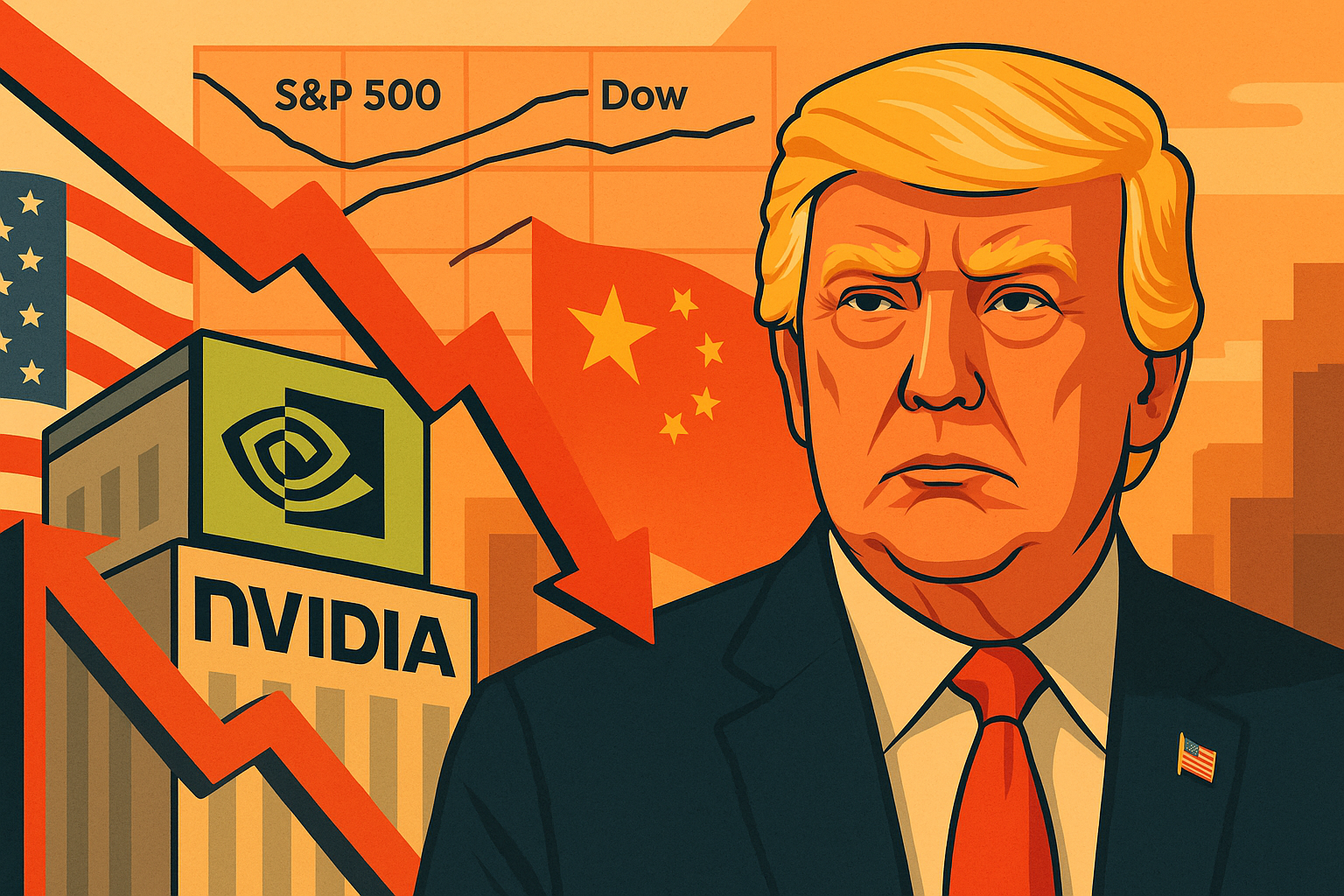
Nvidia shares were down 1.4% at $182.36 on Wednesday after slipping 0.3% in the previous session, while the S&P 500 was flat and the Dow Jones Industrial Average rose 0.2%.
The stock continues to struggle under the weight of policy uncertainty and rising competitive pressures in China, a market that once represented a substantial portion of its AI chip demand.
Investors had initially hoped for a lift from President Donald Trump’s announcement that he would allow shipments of Nvidia’s H200 artificial-intelligence processors to China, but only if the company agreed to give the US government a 25% cut of sales.
Chinese authorities have yet to confirm whether domestic buyers will be permitted to purchase the processors, leaving the outlook unresolved.
The China complications
According to reporting cited from The Wall Street Journal, H200 chips destined for China would be manufactured in Taiwan but routed through the United States for a national-security review before being exported.
Such a requirement could slow deliveries and introduce new compliance burdens.
Further complicating matters is a report from The Information that Chinese AI startup DeepSeek is allegedly using several thousand of Nvidia’s current-generation Blackwell chips to train its next model.
The publication said the hardware was smuggled into China by dismantling servers purchased in jurisdictions where the chips can still be legally sold.
The claims add a new layer of tension to Nvidia’s China narrative, underscoring both strong Chinese demand and the regulatory risks surrounding high-end semiconductor sales.
Analysts on Nvidia stock
UBS analyst Timothy Arcuri reiterated a Buy rating and a $235 target price, estimating that resumed China shipments could generate an additional $5 billion to $10 billion in quarterly revenue if permitted.
He also noted that such sales would sit atop an existing order backlog of roughly $500 billion.
But others caution that the real upside may be limited. BNP Paribas analyst David O’Connor wrote in a new client report that Nvidia and Advanced Micro Devices could benefit if export rules ease, but industry-wide supply constraints remain an obstacle.
He highlighted shortages in memory, packaging capacity and wafers at Taiwan Semiconductor Manufacturing Co.’s most advanced production lines.
These lines are already heavily booked by leading customers, including Nvidia, limiting availability through 2026.
BNP also noted that demand from China may not be as robust as investors assume.
Domestic chipmakers such as Huawei, Biren and Moore Threads continue to advance their own high-performance processors.
Chinese authorities may also set restrictions on certain types of foreign chips or encourage buyers to diversify suppliers rather than rely on a single US vendor, which would dilute potential gains for Nvidia and AMD.
Nvidia stock: buy, sell or hold?
Despite the broader concerns, some market voices remain firm.
CNBC host Jim Cramer urged investors to avoid trading the stock around near-term headlines, arguing, “Own it, don’t trade it.”
He characterised recent weakness as a reaction to fear rather than fundamentals, pointing to Nvidia’s long-term demand profile.
Still, Nvidia shares are down 1.7% over the past month — a small decline in percentage terms, but one that represents roughly $80 billion to $100 billion in market value for a company of its size.
The post Why Nvidia stock is failing to rally despite Trump’s China chip pivot appeared first on Invezz