










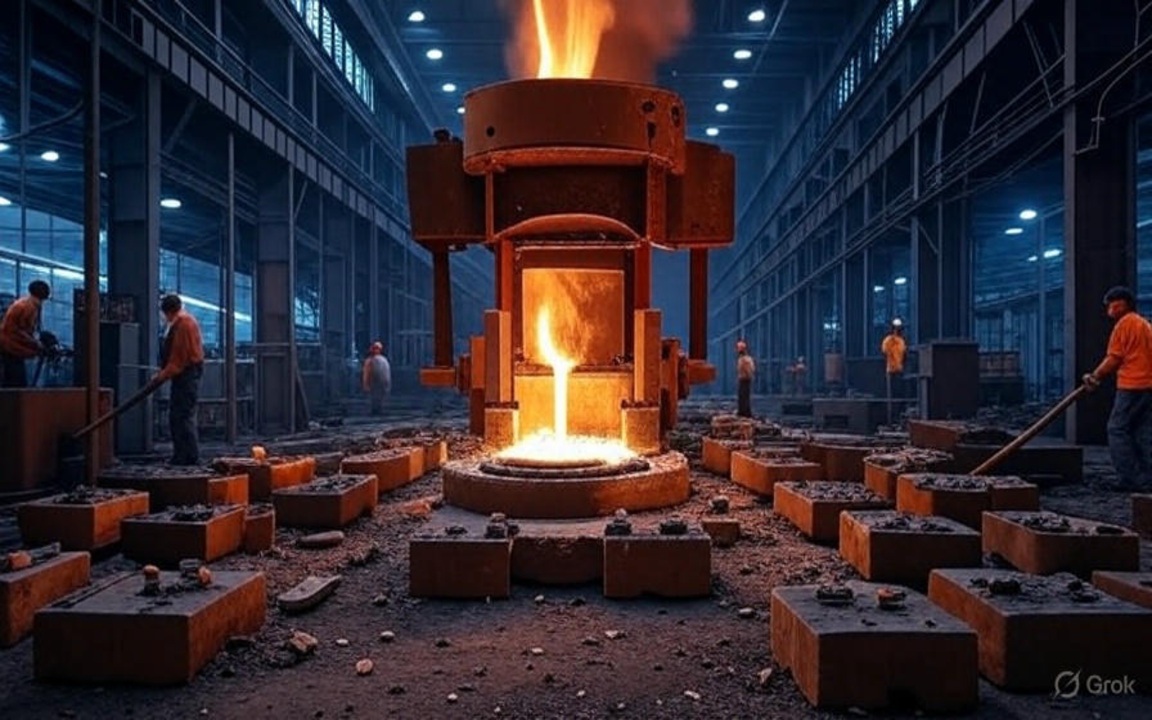
Latin America’s steel industry is under increasing strain as surging imports from China squeeze local markets and stall growth, despite the region’s rising demand for building materials.
Industry officials argue that domestic producers face an uneven playing field, distorted by government subsidies and artificially low prices that favour Chinese steel.
According to Ezequiel Tavernelli, president of the Latin American Steel Association (Alacero), the primary concern is the sheer scale and nature of China’s state support.
He described China as “a monster that competes under different rules,” fueled by a complex web of subsidies covering raw materials, working capital, low-interest loans, and bailouts for loss-making firms.
“We are no longer competing company against company; we are competing company against a State, and there is no way to compete against a State,” Tavernelli told Spanish news agency EFE.
Global overcapacity raises export pressure
The imbalance is exacerbated by China’s massive production capability.
According to Alacero estimates, worldwide demand for crude steel reached 1.87 billion metric tons in 2024, with China producing 1.005 billion tons alone.
By the end of the year, China had an excess capacity of 249 million tons ready for export, which exceeded the production needs of numerous regions across the world.
The outlook shows that there will be more pressure in the future.
The Organisation for Economic Cooperation and Development (OECD) has cautioned that with Chinese investments planned until 2027, including projects in Southeast Asia, surplus capacity might exceed 720 million tons.
Imports reshape Latin American consumption
Alacero estimates that in 2025, imports will account for 39.7% of total steel consumption in Latin America, meaning roughly four out of every ten kilograms of steel consumed in the region are imported.
China represents 45.4% of those imports.
Between January and October 2025, China sold more than $59.3 billion in steel and $87.5 billion in steel-derived products, according to Chinese government figures.
Exports totalled $3.32 billion to Brazil, $1.61 billion to Chile, and $345 million to Argentina.
Job losses and closures across key economies
In Argentina, imports of Chinese steel exceeded $248 million by October, surpassing the total recorded in 2024.
The Metalworkers’ Union (UOM) reported that since President Javier Milei took office in December 2023, around 20,000 jobs have been lost across the union’s various branches.
The UOM notes that rising Chinese imports are only one factor; the downturn has been exacerbated by falling economic activity, which has reduced demand in construction and the automotive industry.
Brazil’s steel industry has warned of a “risk of collapse” amid record import levels, 64% of which come from China.
In response, the country implemented a 25% tariff on steel imports until 2026.
Chile has already experienced direct impacts. After years of losses and a severe financial crisis, Huachipato, the country’s largest steelmaker, was forced to close in August 2024 due to Chinese steel imports.
The post Latin American steel industry faces strain from Chinese import surge appeared first on Invezz