












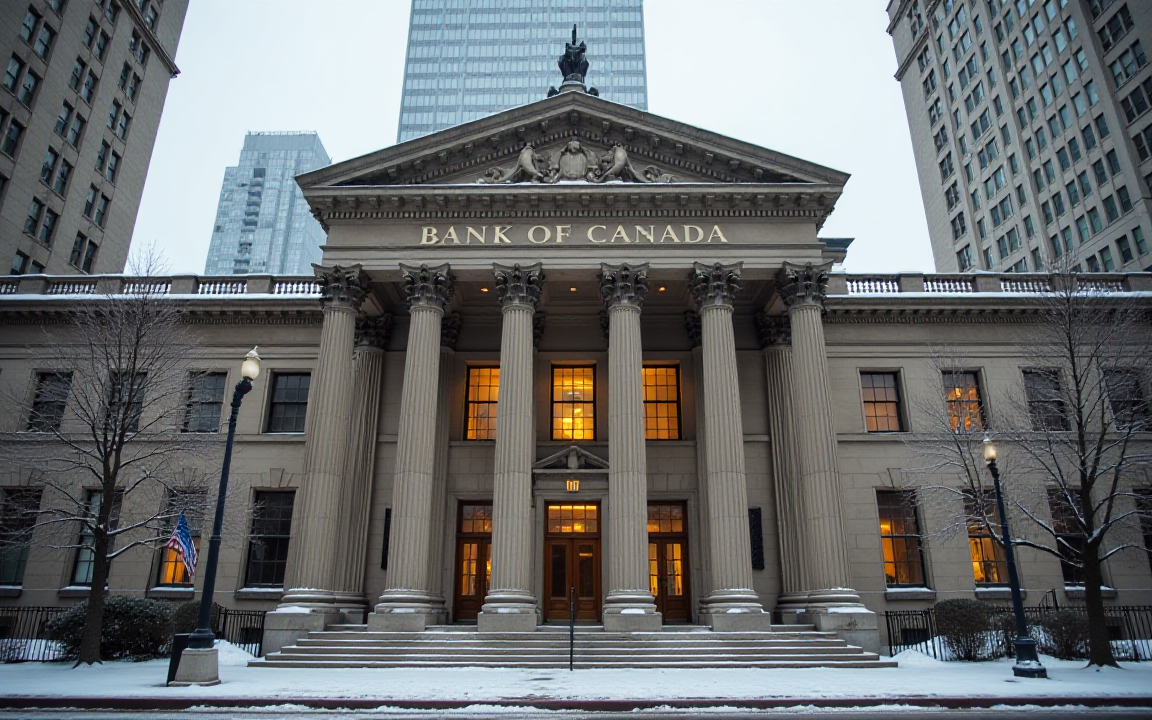
The BoC is expected to keep its policy interest rate at 2.25% on Wednesday, which would extend the current pause in monetary policy since a long series of adjustments last year.
But economists and money markets are split on the direction Canada’s monetary cycle should take for the remainder of 2026 as uncertainty lingers over the economy.
However, after a nearly a year-long pause period through most of 2025, market participants have gradually increased the likelihood of a rate hike later this year since December.
Other economists have warned that the result is still largely contingent on the ongoing renegotiation of the US-Mexico-Canada Agreement (USMCA), which continues to create uncertainty around trade and investment climates.
A neutral position, after the cuts of last year
The BoC indicated in October that inflation was mostly contained within its goal range and that its benchmark rate was at a suitable level after cutting interest rates by 25 basis points.
Policymakers at the time admitted that they had few resources at their disposal to deal with structural issues brought on by US tariffs and the uncertainty that accompanied them.
According to money market pricing, policy rates are anticipated to either stay the same or slightly decrease through the middle of 2026 before beginning to gradually tighten in the last quarter.
The policy rate is at the lower end of the BoC’s neutral range, which is a level where rates neither boost nor restrict economic activity, according to analysts who point out that last year’s cumulative 100-basis-point drop put it there.
True stimulus, according to some economists, would necessitate further rate reductions below the neutral threshold.
Chief economist Doug Porter of BMO Capital Markets noted that a neutral position might not be enough to sustain economic growth in the face of growing unemployment and persistent trade uncertainties.
Trade uncertainty dampens business sentiment
According to a recent survey conducted by the Bank of Canada, Canadian business sentiment across the sectors continues to be soft and is impacted by trade tensions, while Canadian consumers worry more about job security and whether they can repay their debts.
Nevertheless, wider economic gauges have pointed to a reduced contagion from US tariffs outside of steel, aluminium, lumber and automotive.
Inflation has stayed in check, growth has been slow, and the labour market’s been decent between September and November.
This gap between economic data and sentiment highlights the dilemma that the BoC faces.
However, with some ambiguity over trade and employment, these headline numbers could play a role in future policy.
Policy outlook forecasts diverge
Nearly 75% of the 35 economists surveyed by Reuters recently predicted that the central bank would keep rates the same through 2026, a significant rise from just over 60% in December.
Instead of starting a full tightening cycle, Tony Stillo, director of Canada Economics at Oxford Economics, said that rates would probably stay on hold for about a year before a slight increase that would bring the policy rate back toward the neutral midpoint.
This prediction, Stillo warned, is predicated on a successful USMCA renegotiation, which may reduce tariffs on specific industries.
Any rate rises’ scope and timing are still dependent on labour market conditions, inflation trends, and trade events.
Future announcement of monetary policy
On January 29 at 10:00 AM ET (15:00 GMT), the BoC will make its monetary policy announcement.
The move will be accompanied by the publishing of the central bank’s quarterly Monetary Policy Report, which will resume its practice of offering single-point projections for inflation and economic growth.
These forecasts will be widely watched by analysts and investors for clues about how the BoC intends to handle persistent uncertainties in employment, trade, and overall economic circumstances.
The post Bank of Canada likely to hold rates amid uncertainty over trade and growth appeared first on Invezz