











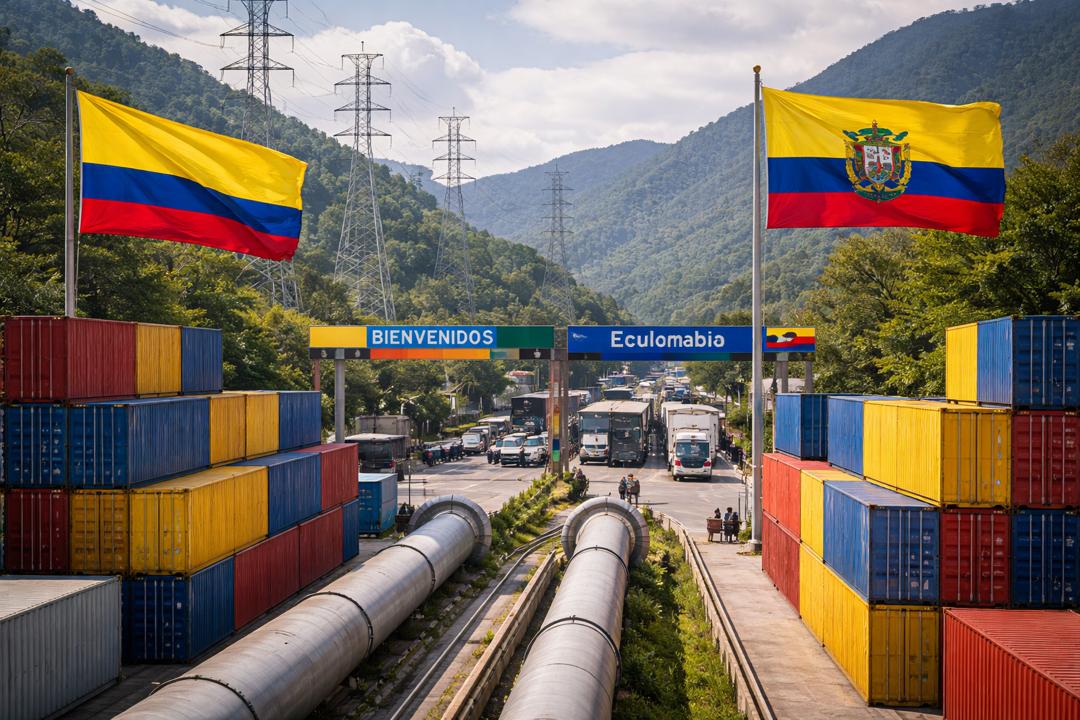
On Thursday, Colombia announced the suspension of the provision of electricity to Ecuador and a 30% tariff on 20 goods from the neighbouring country, broadening a dispute over trade deficits into mutual allegations of non-compliance with drug trafficking cooperation.
It was the latest measure in a fast-moving tit-for-tat between the two Andean nations.
Noboa, Ecuador’s president, announced the imposition of a 30% “security charge” on goods from Colombia to his country starting February 1.
The announcement was made a day before his statement on Saturday.
Noboa pointed to Ecuador’s trade deficit with Colombia and what he called low “cooperation” in the fight against drugs as justifications for the measure.
Colombia has previously denied allegations of not combating drug trafficking and has emphasised its contribution to regional security.
That dispute has since grown from simple tariffs into energy exports, oil logistics and a wider frame of diplomatic back-and-forth by the two respective governments.
Energy exports and reciprocal measures
Colombia is a major electrical supplier to Ecuador, and the first announcement from Quito included some limitations to the proposed actions.
Noboa’s government later stated that the 30% charge would contain exemptions for the sale of power and oil logistical services, implying that energy flows would not be immediately disrupted.
However, following Colombia’s pricing decision on Thursday, Ecuador’s energy minister stated that Colombian crude delivered via Ecuador’s second-largest oil pipeline, the OCP, will get “the reciprocity given in the case of electricity.”
She did not elaborate on how the reciprocity would be used in practice.
Later on Thursday, Colombia’s energy ministry announced a resolution suspending “international transactions of electricity with Ecuador.”
The ministry did not directly connect the move to Ecuador’s trade sanctions, instead defining it as “a preventative measure to guarantee internal supply in the face of climate variability.”
It stated that electricity exports would resume once “adequate technical, energy, and commercial conditions exist.”
Edwin Palma, Colombia’s energy minister, has previously condemned Ecuador’s actions and on Wednesday halted a recent effort that would have allowed private enterprises to participate in energy sales between the two countries.
Trade imbalance at the centre
The economic backdrop to the dispute is highlighted in trade figures. According to Ecuador’s central bank, the trade imbalance with Colombia stood at $838 million in the first ten months of last year.
Data from Colombia’s statistics agency DANE showed that in the first 11 months of stretching to 3.6% of the country’s total exports, Colombia sent $1.67 billion worth of goods to Ecuador.
The commerce and industry ministry of Colombia said in an overnight post on X that the 30% tariff announced was “proportional, transitory and reversible,” and sought to recover balance in trade relations after the decision by Ecuador for what it termed “security charge.”
Colombia remains willing to dialogue, the ministry said.
Colombia did not immediately state on which products the tariff would apply. Ecuador’s main exports to Colombia include fish, vegetable oil and auto parts, according to official data.
Drug trafficking accusations are denied
The trade and energy policies are being implemented alongside heated debates over security cooperation.
Colombian President Gustavo Petro dismissed charges that his country has not done enough to combat drug trafficking, describing collaboration with Ecuador’s security forces as “tight.”
Petro said on Wednesday that Colombia had confiscated 200 metric tons of cocaine along the two countries’ common border.
He also expressed his expectation that Ecuador would be appreciative of Colombia’s assistance when it was needed and that his government was eager to increase cooperation efforts to combat fentanyl trafficking.
The conflict occurs while Noboa has made combating criminal groups a fundamental pillar of his government.
He has closely allied Ecuador with the United States on security policy, presenting the fight against organised crime as a top priority for the country.
As both governments harden their positions, the combination of tariffs, suspended electricity sales, and warnings about oil logistics demonstrates how a dispute over trade and security has quickly escalated into a more complex bilateral conflict, with economic and energy ties now directly at stake.
The post Colombia halts power exports to Ecuador as trade dispute escalates appeared first on Invezz